|
|
|
Trees
The following are great shade trees for
Southern California school campuses, suggested
by Frank McDonough, Horticulturist and Botanical
Information Consultant at The Los Angeles County
Arboretum and Botanic Garden.
Deciduous Shade
Trees
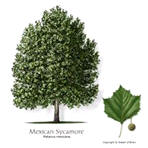 Mexican
Sycamore / Platanus mexicana Mexican
Sycamore / Platanus mexicana
This
newly introduced tree is Mr. McDonough's first
choice for shade at Southern California schools.
"The best bet for lots of shade in the minimal
amount of time."
Can grow to 50-80 feet tall and over 30 feet wide.
A good choice where you want the maximum amount
of shade for your investment.
Does well in almost all Southern California
climates. If irrigated properly, root damage is minimal
for a tree of its size. The Mexican
Sycamore is less susceptible to the anthracnose
leaf fungus and is considered "water saving."
[The former top choice in this category, the
London Plane Tree (a relative of this species),
is also very good for shade but has fallen out
of
first place due to its pollen being moderately
allergenic.]
Additional information - Frank
McDonough, Botanical Info. Consultant, L.A.
Arboretum (626) 821-3236
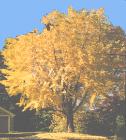 Maidenhair tree / Ginkgo biloba Maidenhair tree / Ginkgo biloba
Although slow growing at first, Ginkgo's
hardiness in urban situations makes it
well worth the wait.
Besides growing to 80 feet in height and almost
60 feet in width, this tree puts on a
spectacular fall foliage show. Plant only the male clones. (Female trees
produce a foul-smelling fruit).
Additional information - UConn Plant
Database
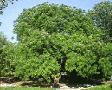 Silk tree / Albizia julibrissin Silk tree / Albizia julibrissin
Provides a broad, umbrella-like canopy of finely
cut leaves.
Its shade is somewhat less dense than other
shade trees, so it lends itself to shading
areas where more light might be required.
Produces beautiful pink pom-pom flowers in the
summer.
Be sure to get a variety resistant to "wilt"
caused by the fungus, Verticillium.
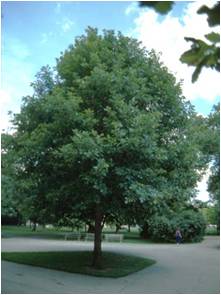 Monterrey
Oak / Quercus polymorpha Monterrey
Oak / Quercus polymorpha
Also known as Mexican Oak or Mexican White Oak,
this drought tolerant deciduous oak, native to
Mexico and south Texas, grows 2 1/2 ft/yr to a
mature height of 45 feet. This oak is not
known to be susceptible to a new pest, the
polyphagous shot hole borer, which is killing
east coast oaks (English, Red, and Pin Oaks) in
southern CA.
Additional information - UConn Plant
Database
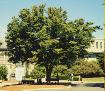 Sawleaf Zelkova / Zelkova serrata Sawleaf Zelkova / Zelkova serrata
Vase shaped moderate sized shade tree.
Zelkova is a Japanese relative to the American
elm, but is
less susceptible to diseases that make American
elms a poor choice.
Green Vase variety is fast-growing to 70 feet.
Additional information - UConn Plant Database
Mr. McDonough adds...
The above trees are all deciduous
species. There will be cleanup maintenance
in the fall when all the leaves are dropped, but
for most school-based applications this would
result in less overall maintenance compared with
the relatively constant messiness of evergreen
trees. Considering the size of the shade
canopy, there will be less problem with surface
root damage with the recommended deciduous trees
than with most evergreens. Of course,
there will be no significant shade provided when
a deciduous tree is bare, but when it leafs out
again in the spring, these trees do tend to
produce a better shade canopy.
Evergreen Shade Trees
In some situations, year-round greenery might be
preferred. For example, a few evergreen
trees might be sprinkled in among a
predominantly deciduous planting for a more
aesthetically pleasing landscape design.
Density of shade, growth rate, messiness, and
surface root damage were all taken into
consideration in the following three
recommendations from Mr. McDonough.
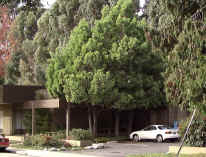 Fern Pine / Podocarpus gracilior Fern Pine / Podocarpus gracilior
Moderate growth rate to 30 feet.
Quite messy but excellent near foundations with
little risk of surface root damage.
Mr. McDonough's first choice evergreen shade
tree.
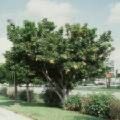 Carrot Wood / Cupaniopsis anacardioides Carrot Wood / Cupaniopsis anacardioides
A very beautiful evergreen tree.
Moderate to slow grower to 35 feet.
Subject to root rot with heavy water so not good
in lawns.
Produces fruit which can be messy.
Constantly sheds leaves.
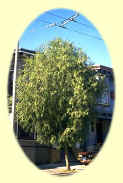 Australian Willow / Geijera parviflora Australian Willow / Geijera parviflora
Not as dense a shade canopy as others above.
Slow to moderate growth.
Resents heavy watering (don't plant in lawn
area.)
Somewhat messy.
Additional Information:
|
|